

Fix Your Web Design & Stop Wasting Traffic
Every year, thousands of growing businesses fall into the exact same expensive digital marketing trap. They invest heavily in a polished rebrand, hire a talented photographer, and launch a visually stunning website. Then, they pump money into social media campaigns and targeted digital advertisements to drive a massive wave of new visitors to their corner of the internet.
On paper, everything looks like a resounding success. The traffic charts in your monthly analytics reports show a beautiful upward curve. Your click-through rates look promising. But when you look at your bottom line, something is fundamentally broken. The phones aren’t ringing, contact forms sit empty, and your e-commerce shopping carts are abandoned at an alarming rate.
Design is no longer just a visual asset for the creative department. It is a financial driver. Data highlighted by the Harvard Business Review shows that companies that intentionally lead with a unified brand strategy across all digital touchpoints consistently outpace their competitors in market growth.
This disconnect highlights a costly reality in modern digital marketing: “pretty” traffic means absolutely nothing if your underlying brand strategy is completely disconnected from your web design. When your visuals and your strategic messaging pull in opposite directions, you aren’t building a business; you are simply subsidizing expensive web traffic that bounces away to your competitors. To stop losing revenue on underperforming campaigns, growing brands must understand the underlying psychology of online trust, fix the friction points hidden within their user experience, and implement a unified strategic blueprint.

The Illusion of Aesthetics: Why Visuals Alone Fail to Convert
It is easy to see why business owners over-index on pure aesthetics. First impressions happen fast online. When a user lands on your home page, a subconscious decision occurs in less time than it takes to blink. Your choice of color palettes, typography, and layout immediately signals whether your business is modern, corporate, creative, or luxury.
However, visual appeal is merely an invitation; it is not a closing argument. A common symptom of a disjointed digital presence is a high traffic volume paired with a punishingly high bounce rate, the percentage of visitors who leave your site after viewing only one page. This occurs because of a mismatch between consumer expectations and actual content delivery.
If your paid advertisements or top-of-funnel content marketing make a specific promise, but your landing page fails to instantly reinforce that exact promise visually and textually, your visitor experiences immediate confusion.
In the digital space, confusion is the ultimate conversion killer. If a prospect has to spend more than a few seconds trying to figure out what you actually do, who you serve, and how you solve their specific pain point, they will simply click away. A beautiful layout might catch their eye, but only a cohesive, strategically sound structure will hold their attention long enough to convert them into a paying customer.

The Psychology of Trust: Lowering Friction in the User Experience
To turn cold traffic into loyal clients, your digital home base must act as a trust-building engine. Trust online isn’t built through flashy animations or generic stock photography. It is built through absolute consistency across every single digital touchpoint.
This is where the concept of UX alignment becomes critical. UX, short for user experience, encompasses every single interaction a prospect has with your business online. It includes everything from how intuitively your navigation menu is structured to how quickly your mobile pages load.
When your underlying brand strategy is accurately mapped to your website layout, you drastically minimize conversion friction. Friction refers to any element of your website design or copy that causes a user to hesitate, feel confused, or abandon their journey.
Friction can look like an overly complicated three-page checkout process, a hidden phone number, or vague, jargon-heavy headlines that obscure your actual value proposition.
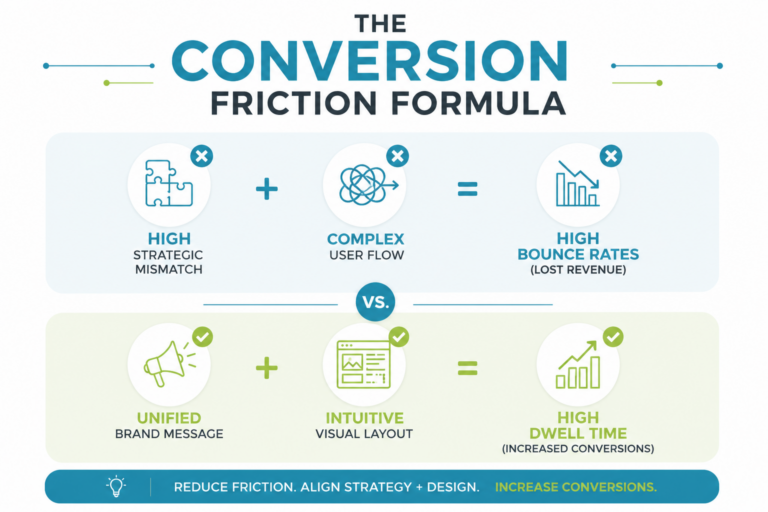
By prioritizing consistency in your strategic messaging and visual hierarchy, you systematically lower that friction. When your visual assets, brand identity, and user pathways perfectly mirror the expectations set by your marketing, you build immediate subconscious credibility.
This deep alignment directly influences your site’s dwell time, the actual duration a visitor spends actively interacting with your content before returning to the search engine results. Search engines like Google monitor these engagement metrics closely. A longer dwell time signals to algorithms that your site provides high-value, relevant answers, which naturally boosts your long-term organic search rankings.

The Full-Service Advantage: Merging Strategy and Technical Execution
Many businesses suffer from disjointed web performance because they hire their creative teams in isolated silos. They work with an independent brand strategist to develop their values and messaging guidelines, pass those notes along to a freelance graphic designer for a logo, and then hire a separate web development agency to code the site.
This fractured approach leaves massive gaps in execution. The web developer might construct a technically perfect, fast-loading site, but if they don’t understand the psychological triggers of your ideal target audience, the user pathways won’t lead to conversions. Conversely, a stunning creative concept from a designer might completely fall apart if it isn’t optimized for modern search parameters or intuitive user navigation.
To build a high-converting digital presence, your business needs to treat brand building, website design, and traffic generation as a single, unified ecosystem. True strategic positioning means your creative visuals are always anchored by concrete data. Every design decision, from the placement of a primary call-to-action button to the layout of an internal resources page, must be made with a clear understanding of how it moves a prospect closer to a buying decision.
When you bridge the gap between creative storytelling and analytical optimization, you transition your website from an expensive digital brochure into your company’s hardest-working sales asset.

The 3-Step Digital Alignment Audit
If you suspect your current web traffic isn’t generating the return on investment it should, you don’t necessarily need to tear everything down and start from scratch. Often, small, intentional adjustments to your core messaging paths can yield massive improvements in user engagement.
Use this simple, three-step audit to evaluate how cleanly your brand strategy matches your web design:
1. Analyze Your Message-to-Market Match
Review your current active paid traffic campaigns, social media posts, and search engine snippets. Now, open your primary landing pages on both a desktop computer and a mobile device. Does the headline on your website immediately echo the core value proposition promised in your external marketing? If your ads promise an accessible, stress-free consulting process, but your website greets users with dense blocks of mechanical text and a rigid interface, your message-to-market match is broken.
2. Identify and Map Hidden Traffic Gaps
Dive into your analytics dashboard to review your most heavily trafficked landing pages. Look specifically for pages that enjoy a high volume of unique visitors but suffer from exceptionally low time-on-page metrics or flatlined form completions.
These gaps indicate a structural disconnect. It means your search optimization or ad targeting is successfully generating high-intent interest, but the physical layout or copy on that specific page is failing to guide the user naturally to the logical next step in your sales funnel.
3. Simplify the Primary Conversion Pathway
Pretend you are a first-time visitor trying to purchase your primary service or contact your sales team. How many clicks does it take from the moment you land on the home page to complete that action? Are your call-to-action buttons visually distinct, or do they blend quietly into your background color palette?
To maximize conversion optimization, eliminate any unnecessary fields in your forms, keep your navigation menu uncluttered, and ensure that your primary call-to-action remains easily accessible on every screen size.

Transform Empty Clicks into Strategic Business Growth
Driving traffic to an unoptimized, mismatched website is the equivalent of pouring water into a leaky bucket. It doesn’t matter how beautiful or expensive the bucket is, if the structural foundation isn’t sealed around a single, cohesive customer experience, your resources will continue to slip away.
As a business owner, your goal should never be to accumulate superficial vanity metrics like empty clicks or “pretty” traffic. The true measurement of digital success is your conversion rate, how effectively your online footprint turns curious browsers into long-term brand advocates.
Investing in a comprehensive brand strategy is the vital first step toward creating a business identity that commands attention. But to truly unlock your growth potential, that identity must be meticulously woven into your technical website design and optimization.
When your visual hierarchy, technical functionality, and core messaging work together in perfect harmony, your digital marketing campaigns become significantly more efficient. Your bounce rates drop, your page authority strengthens, and your marketing expenses transform from an operational cost into a scalable engine for predictable revenue growth.
Ready to close the gap between your marketing investments and your business results? Our strategic team specializes in building unified digital ecosystems that turn high-intent traffic into measurable revenue.
Whether you need to audit your active Google Ads management campaigns or completely overhaul your digital customer experience, we can help. Say hello to the BoBella Brands team today to schedule a comprehensive brand and web evaluation, and let’s start turning your web traffic into profit.