
If you’re a local business struggling to show up consistently, the issue is rarely effort. Most businesses are active, posting on social media, networking locally, and trying to stay visible, but results still feel unpredictable.
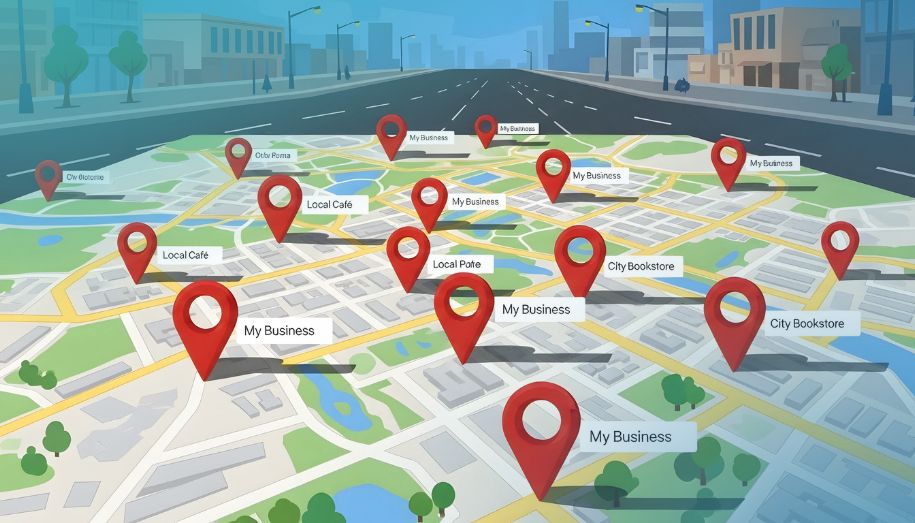
A consistent local visibility strategy uses multiple channels, but it prioritizes the ones that capture demand when people are ready to act. For most local businesses, that includes a strong Google presence, including Google Search and Google Maps, because that is where customers go to find a solution in the moment, not just browse.
Google is not the only way people discover a business. Referrals, partnerships, email, community presence, and social media all matter, but when Google visibility is weak and the website does not convert, even strong awareness can fail to translate into consistent leads.
In this article, we will break down what actually drives visibility in your market and how to build a system that produces consistent results. You will also find a quick self-check to pinpoint where your visibility is breaking down right now.

The Myth of “Getting Lucky” With Local Visibility
Many businesses experience occasional spikes in visibility and assume they got lucky. A post performs well, engagement increases, or traffic jumps for a week, and it feels like momentum. These spikes are often misunderstood because they are rarely repeatable without structure behind them. Without a system, the next week looks completely different, and marketing turns into guessing.
Common assumptions:
- Posting more will increase visibility
- Going viral will solve growth challenges
- Algorithms determine success
These beliefs shift focus away from what creates consistent discovery. Social media can support awareness and trust, but most people are not actively searching for your service while they scroll. Local visibility becomes predictable when marketing is built around intent-driven discovery and a clear path to conversion. That means building the assets and channels that perform consistently, not chasing occasional engagement spikes.

Why Most Local Businesses Stay Invisible
Most local businesses are not struggling with visibility because of overwhelming competition. They are struggling because their efforts are scattered across channels that do not produce consistent, high-intent results. It often looks like activity, but it lacks structure. Businesses rely heavily on social media, assume occasional engagement equals growth, and overlook the platforms where real buying decisions are made.
At the same time, the assets that influence real buying decisions are often underutilized or neglected. Google Business Profile listings are often left incomplete or outdated, paid search is underused and not regularly optimized, and websites fail to communicate value or convert traffic clearly. Branding also becomes inconsistent across platforms, which weakens trust. When tracking is missing, it becomes difficult to identify what is actually working and what is simply taking time.
The issue is not a lack of effort. It is that many businesses invest heavily in lower-intent channels while neglecting the channels that capture customers at the moment they are actively looking. When that happens, visibility feels inconsistent even when the business is doing “a lot.”

The 3 Core Pillars of Local Visibility Strategy
A consistent local visibility strategy is built on three interconnected pillars. When one is weak, the entire system underperforms.
- Brand Clarity
If your brand is unclear, your visibility will be ineffective. People need to quickly understand what you do, who you serve, and why they should choose you. Businesses with vague messaging often get ignored, even when they appear in search results. Clarity drives trust, and trust drives action.This includes:
- Clear positioning
- Defined audience
- Consistent visual identity
- Website Structure
Your website must be built for performance, not just appearance. It should be designed to convert traffic coming from Google Business Profile, Google Ads, Local Services Ads, referrals, and social media. Every page should guide users toward a decision with clear structure and clear next steps. If the site creates hesitation, visibility turns into wasted attention.
That means:
- Mobile-first design
- Fast load speeds
- Clear calls to action
- Location-based SEO structure
- Visibility Channels (Execution Layer)
Execution is where strategy becomes measurable. Supporting channels like blog content and social media play a role, but they are rarely the primary drivers of high-intent local discovery. The distinction matters because Google is intent-driven, while social media is interruption-driven and typically supports awareness more than immediate action. A strong visibility system balances both, but it does not confuse them.
Your core channels should include:
- Google Business Profile optimization
- Google Ads campaigns
- Local Services Ads (where applicable)

A Simple Local Visibility Audit (Quick Self-Check)
Before improving your visibility, it helps to understand where you currently stand. Many businesses assume their marketing is working simply because it exists, but without structure, it is difficult to measure impact.
- Start with a simple check. Is your Google Business Profile fully optimized and actively updated, or has it been sitting untouched? Are you consistently showing up in local map results for your core services? If not, visibility is already being lost at the point of highest intent.
- Next, look at your paid presence. Are you running Google Ads or Local Services Ads to capture demand in real time, or are you relying entirely on organic reach? Then shift to your website. When someone lands on it, is it clear what you do and how to take the next step, or does it create hesitation?
- Finally, consider consistency and tracking. Does your branding align across every platform, and can you confidently identify where your leads are coming from? If several of these areas are unclear or inconsistent, your visibility is not yet structured. It is operating on effort, not strategy.
If your self-check is unclear or has failed the test, then keep reading for the simplest solution for your business.
If your current efforts feel scattered or unpredictable, that is usually a sign that the structure is missing. Our role is to bring that structure in, so your marketing is no longer based on guesswork, but on strategy that produces reliable growth. Contact us today for your visibility solutions.